Research interests · portfolio

Models that expose the hidden dynamics.

A growing collection of work in kinetic and fluid plasma simulation, collisionless shocks, laboratory astrophysics, reacting flow, numerical methods, and machine learning for physical systems.

Featured · ALPINE electromagnetic PIC

Sustained magnetron plasma–RF dynamics

ALPINE—Arbitrary Lagrangian Particles Interpolated to Nonuniform Electromagnetics—is a plasma simulation suite built around unstructured finite-element fields, particle dynamics, and compact-support transfer methods. This full-2π six-vane calculation uses charge-conserving particle–field coupling to follow cathode emission, formation of a magnetically confined electron hub, and its interaction with the RF cavity.

At the operating-point window, a seeded π mode grows, organizes the electron cloud into three rotating spokes, and locks to a rotating layer of the hub. The synchronized views show the wave component of Bz, electron azimuthal density, and the π-mode envelope.

  • Unstructured FEM
  • EM-PIC
  • Compact-support transfer
  • Magnetron
  • RF devices

Normalized simulation units. Visualization from the ALPINE M4-phase3 sustained-operation model.
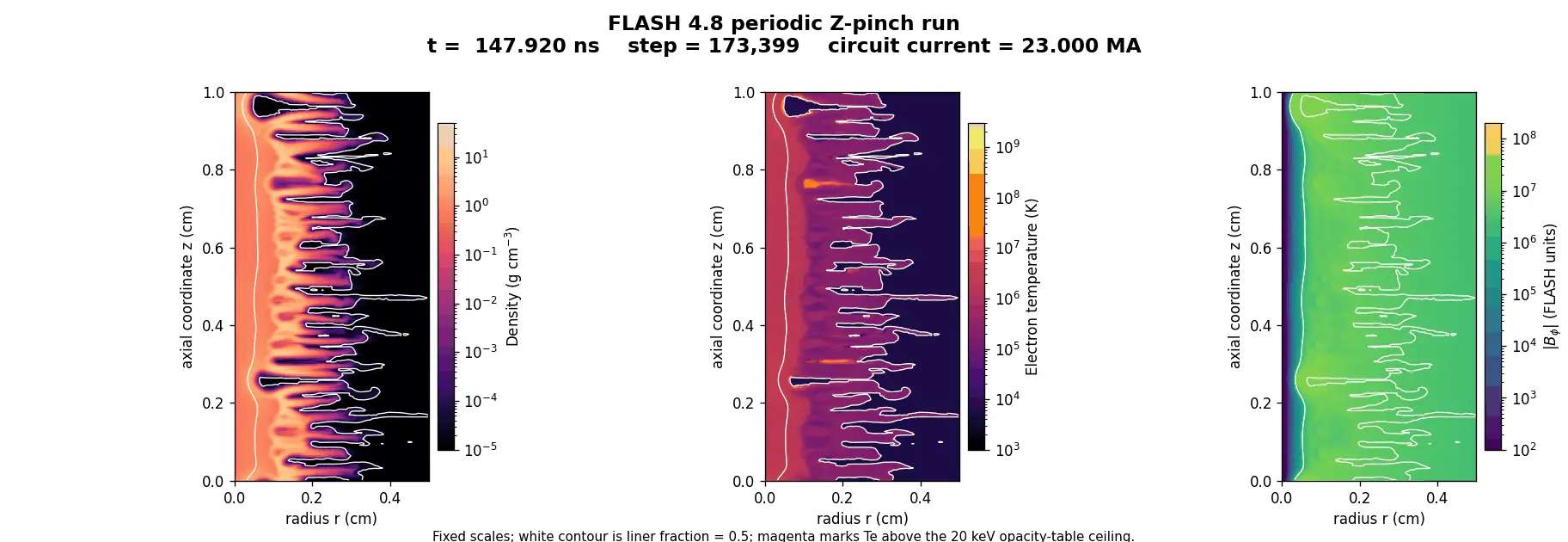
FLASH 4.8 cylindrical Z-pinch at 147.92 nanoseconds showing density, electron temperature, and azimuthal magnetic field with a strongly modulated liner contour

FLASH 4.8 · radiation MHD

Instability in a driven Z-pinch

An axisymmetric r–z FLASH 4.8 calculation follows a beryllium liner imploding around preheated deuterium in a one-centimeter periodic axial domain. Tabulated material properties and a prescribed pulsed-power current waveform drive the liner, while a reproducible 0.1% broadband density perturbation seeds instability.

By 147.92 ns and 23 MA, the saturated modes have produced a strongly nonlinear axial structure: approximately 266 µm RMS and 1.59 mm peak-to-peak liner modulation. The panels show mass density, electron temperature, and azimuthal magnetic-field magnitude; the white contour marks a liner material fraction of 0.5.

  • FLASH 4.8
  • Radiation MHD
  • Z-pinch
  • MHD instability
  • HEDP

Late-time state from the periodic Z-pinch run at step 173,399.

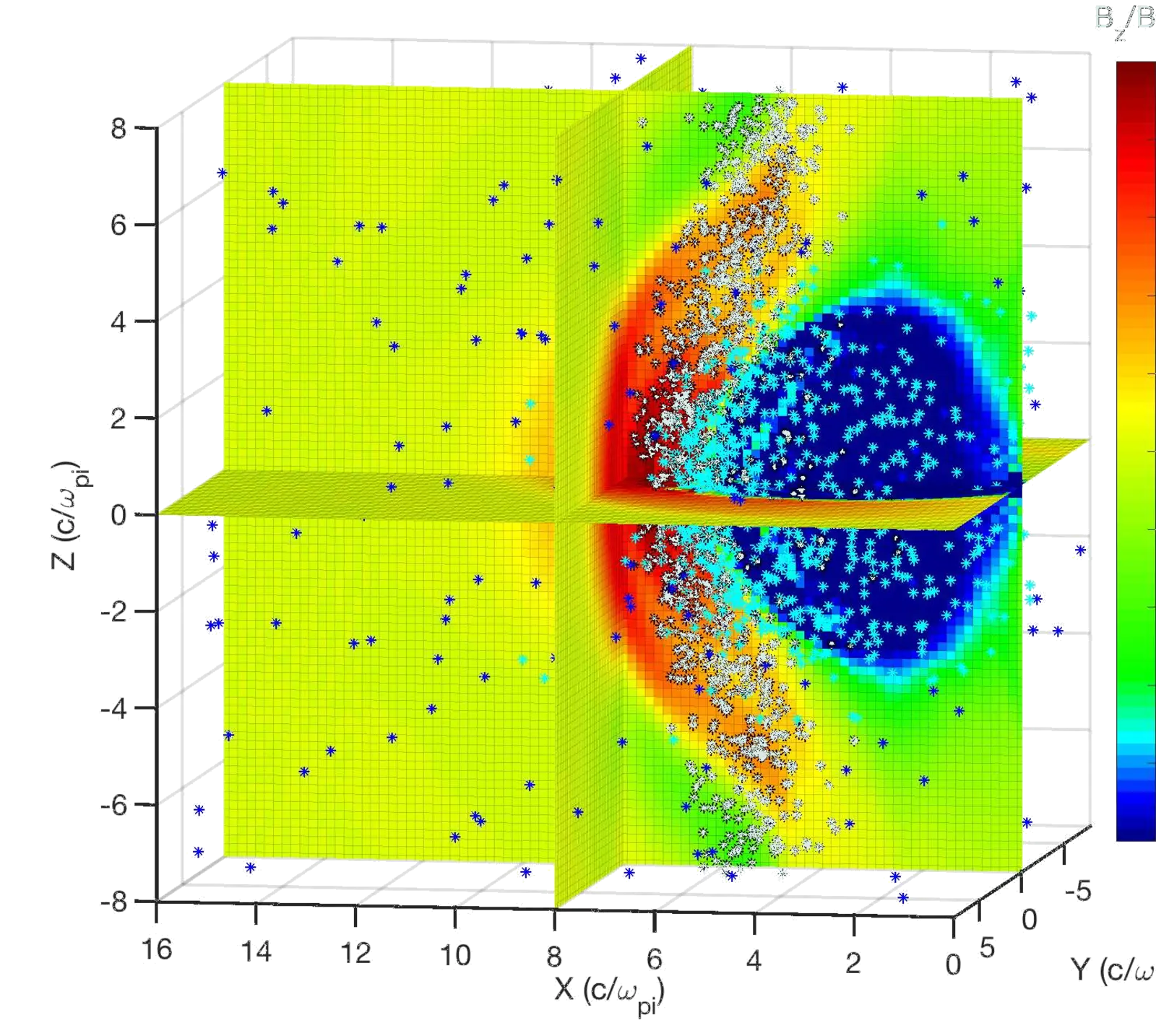
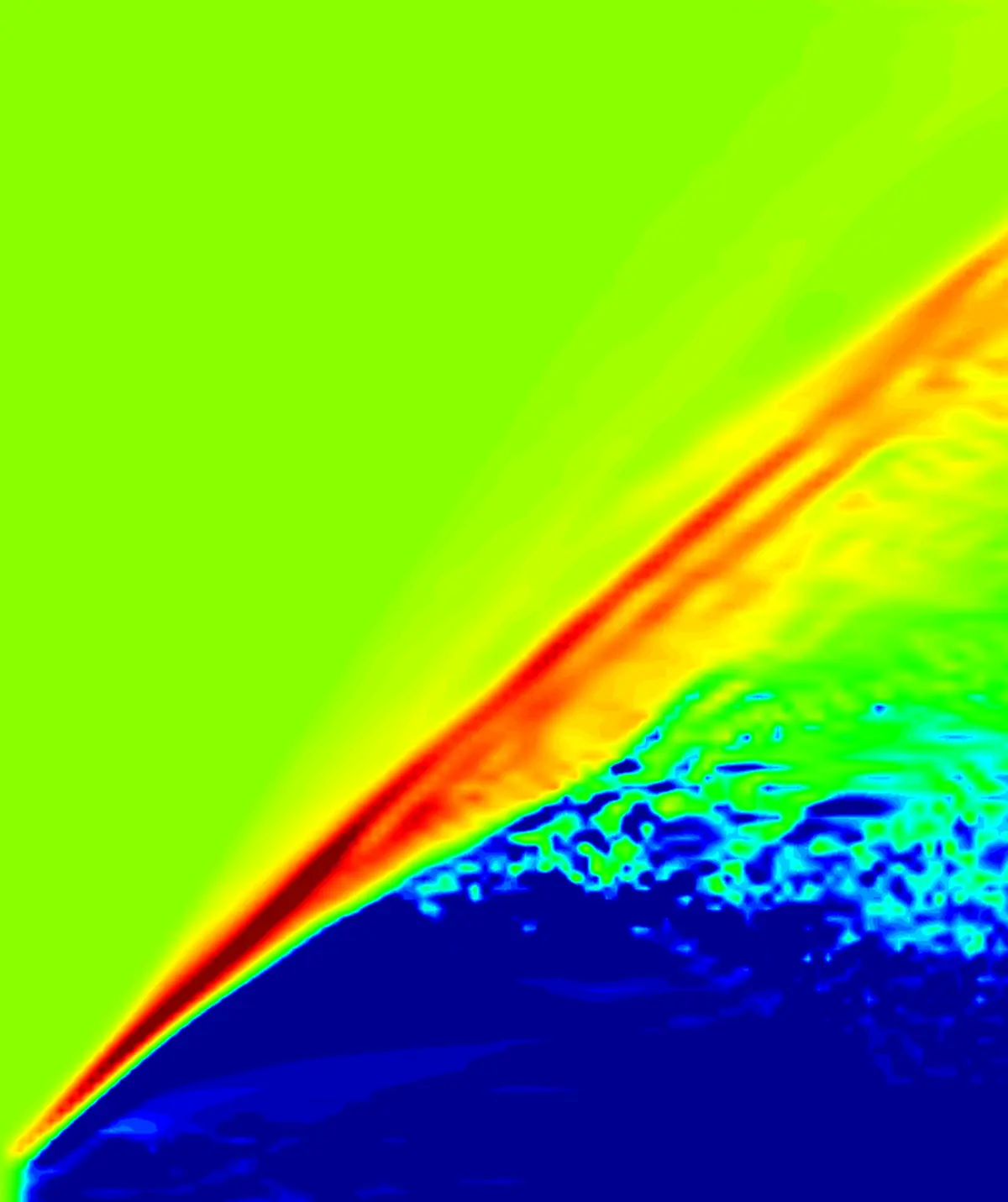
Space-time magnetic field contour from a hybrid simulation of shock formation

Collisionless shocks

From piston formation to propagating structure

Hybrid simulations resolve magnetic compression, debris–ambient coupling, and the evolution of super-magnetosonic disturbances into collisionless shock structures.

  • Shock physics
  • Density gradients
  • Kinetic ions

Space-time magnetic-field contour from the 2016 UCLA dissertation.

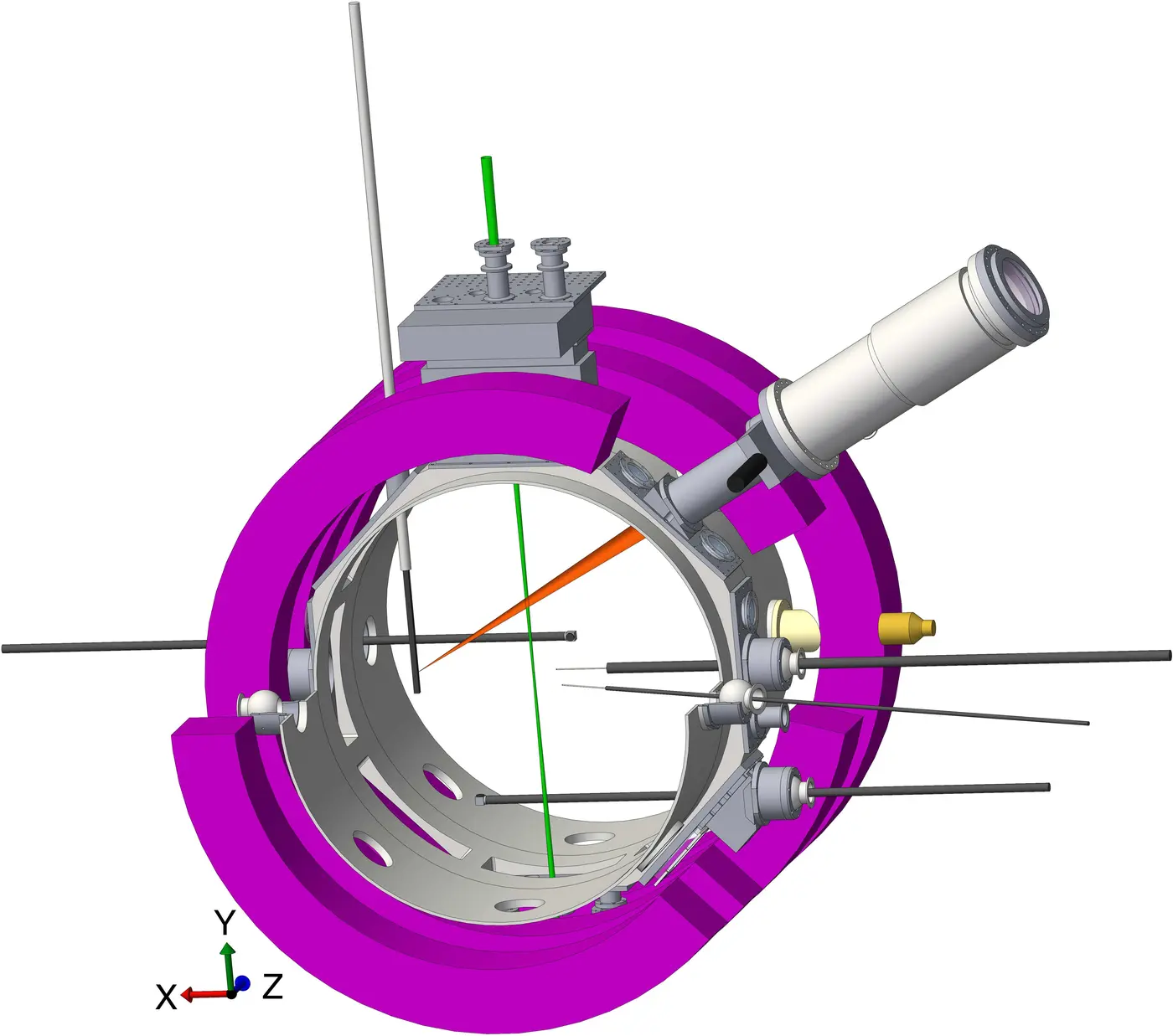
Schematic of probes, laser path, and diagnostics on the Large Plasma Device

Experiment ↔ model

Benchmarking against laboratory plasma

Experiments in UCLA’s Large Plasma Device provided magnetic-field, potential, imaging, and probe data for direct comparison with two- and three-dimensional hybrid simulations.

  • LAPD
  • Diagnostics
  • Validation

Experimental schematic from the 2016 UCLA dissertation.

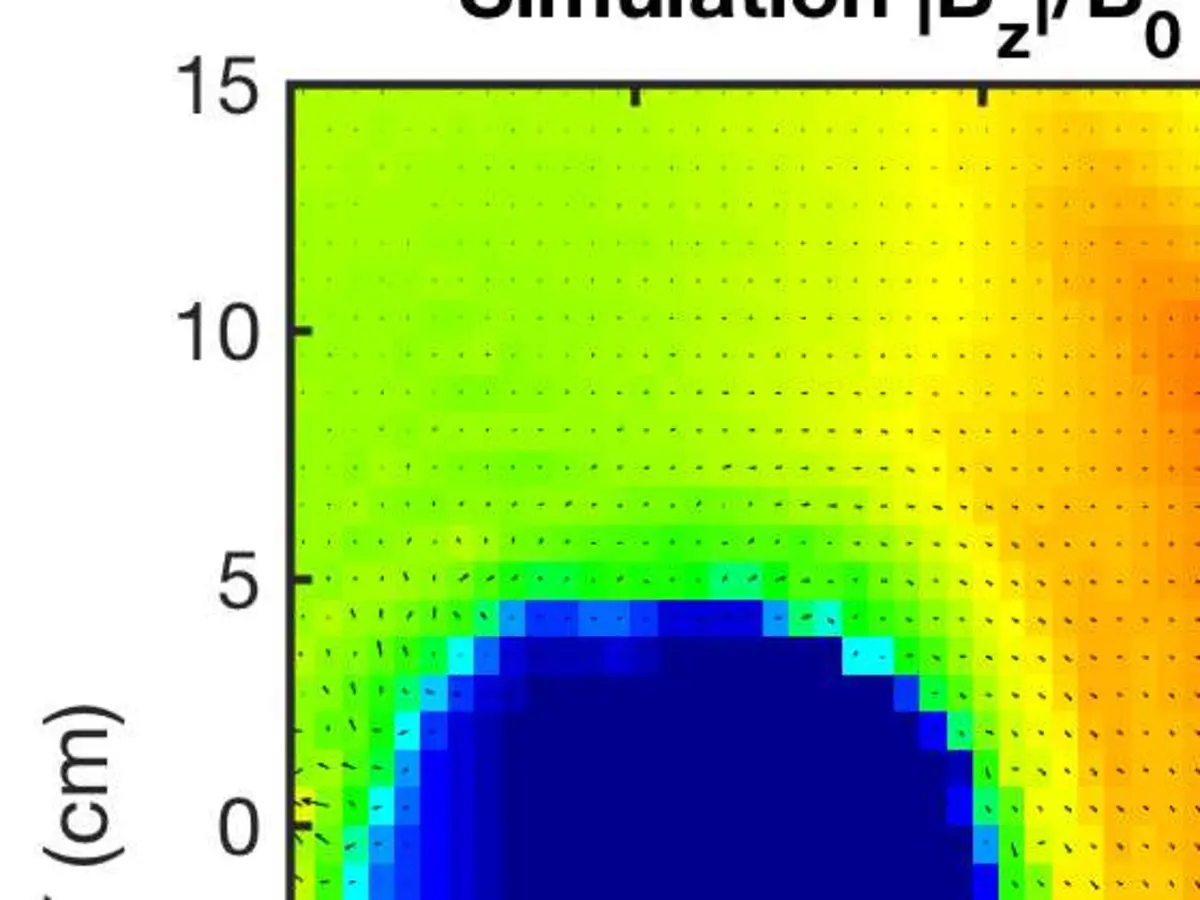
Simulated transverse magnetic field map with vector overlay

Field reconstruction

Model-to-data field comparison

Vector and scalar field products turn simulation state into observables that can be compared directly with diagnostic planes, lineouts, and time histories.

  • Post-processing
  • Field data
  • Uncertainty

Magnetic-field comparison from the 2016 UCLA dissertation.

Portfolio in development

Machine learning for physical systems

Current local work explores scientific machine-learning workflows, surrogate models, and analysis methods for simulation data. Individual projects, validation results, and visual artifacts will be added here as they are prepared for public release.

  • Scientific ML
  • Surrogates
  • Simulation analysis

Research map

Questions across scale and formulation.

The common thread is identifying the smallest model that retains the mechanism under study, then verifying where its assumptions break.

  • Hybrid kinetic–fluid PICKinetic ion populations coupled to fluid electron closures for laboratory, astrophysical, and fusion plasma research.
  • MHD & fluid plasma modelsEquilibria, macroscopic dynamics, closure behavior, and comparisons against kinetic descriptions.
  • Reacting & rarefied flowContinuum CFD, DSMC, chemistry, transport, thermal coupling, and vacuum-system dynamics.
  • Scientific machine learningData-driven models that respect physical structure, with validation against simulation and experiment.
  • GPU scientific computingAlgorithms, numerical performance, and scalable workflows for compute-intensive models.
  • Diagnostics & inferenceConnecting simulated fields and distributions to measurable quantities and uncertainty.

More simulations, images, and movies are on the way.

Explore the publication record